
Power Against Power
Oil, Disorder and Liberalism

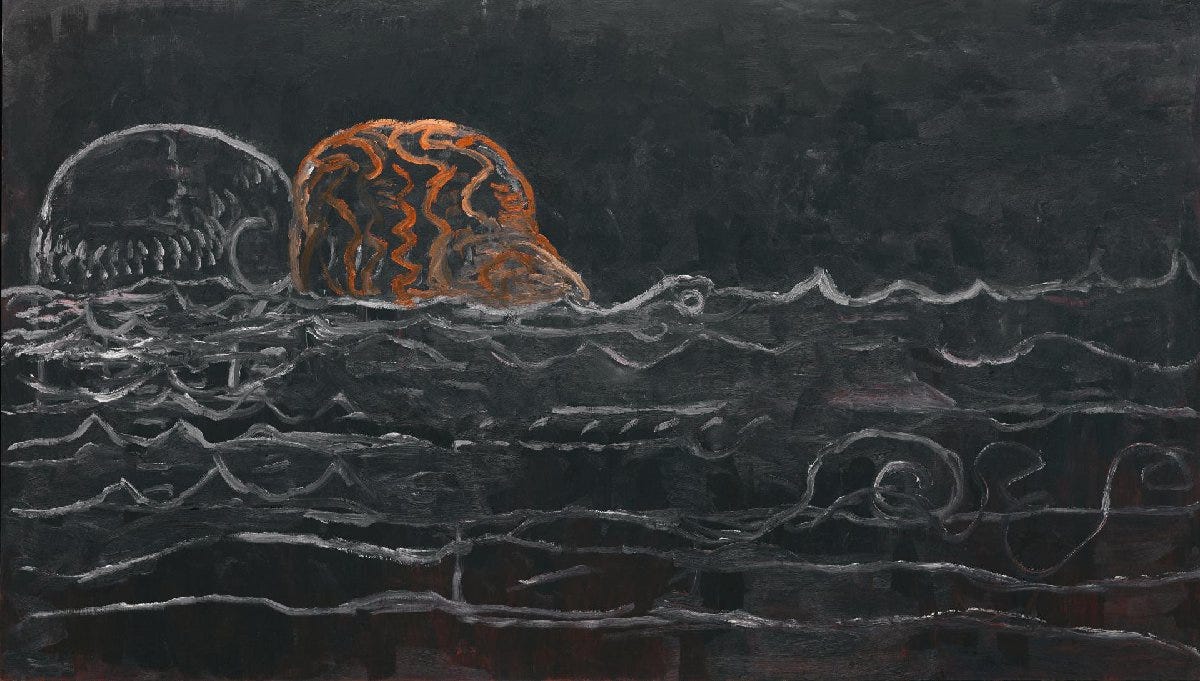
I wrote this several weeks before the horror of the war on Gaza began. It feels now quite out of date. Yet, I think the lines I try to draw from the work of Helen Thompson may still be useful, in putting the current global situation in context. So here’s what I wrote on Disorder.
“Yet in today’s world, the question can be asked: how far does that differ from running with the hare and hunting with the hounds—indignant sympathy for the hare, awed admiration for the hounds? ‘Power must be met with power’. Truly?” (Anderson)
With Disorder, Hard Times in the 21st Century, Helen Thompson has written a sprawling history of the present. The narrative is brilliantly constructed. A vast range of information is elegantly handled. However, I would argue its analysis is lacking, both in an attempt to come to terms with why these are hard times, and where we go from here.
I first came across the work of Helen Thompson while in the food court of an outer London shopping centre. I had run out of podcasts to listen to during my lunch break. From somewhere on the LRB website, I ended up hearing Talking Politics.
An often engaging though academic show, which brought together many of the brightest minds published by the New Statesmen. I listened irregularly up to the first lockdown, perhaps not coincidentally the moment I stopped eating lunch in a shopping centre.
While I was rarely in complete agreement with their interpretation of the world. I found the range of subjects discussed on Talking Politics impressive. They could captivatingly discuss a huge sweep of geopolitical and theoretical topics.
The same is true of Thompson’s book. Discussed in the penultimate episode of the podcast, this book could be seen as a conclusion to the long discussions these left-liberal academics had about the interregnum that ended the last decade.
My contention is that Disorder’s argument, firstly lacks structural coherence and is thus unable to deal with the grand ideologies of the 20th century. Secondly, while it brilliantly draws into focus the history of oil, it cannot explain why this fuel proves so important to our politics. Finally, in Thompson’s detailing of the many travails capitalism has faced, there’s never a clear approach to crises, thus it seems we fall from one to another without a deep enough comprehension of why.
Disorder brings to mind two related definitions. Firstly, simply irregularity. But then also, in a more medical vein; a collection of signs, symptoms and patterns that cause distress or impairment of functioning. This is a clue to the main thrust of Thompson’s work, collecting together a mass of morbid symptoms. While describing them excellently, I would argue Thompson avoids a wider diagnosis and certainly lacks a cure.
The subtitle of Disorder, Hard Times in the 21st Century, stood out to me as particularly clunky. Thompson describes in her introduction, that this is an explicit reference to Dickens’s Hard Times. An outlier amongst Dickens’s oeuvre. It’s a novel focused on a northern industrial town, at the early peak of the British industrial revolution.
Raymond Williams famously compared Hard Times with other industrial novels such as Elizabeth Gaskell’s North & South and George Elliot’s Felix Holt. In his analysis of Dickens's work, Williams argued that Hard Times represented a reaction against the political economy of utilitarian industrial liberalism. For Williams, Dickens’s approach succeeds through abstraction and generalization, without any experience or feeling for the industrial workers described. Moreover, as Williams outlines:
“As a whole response, Hard Times is more a symptom of the confusion of industrial society than an understanding of it, but it is a symptom that is significant and continuing.” (Williams)
Similarly to Dickens’s novel, Thompson’s descriptions of our century's hard times, are in part emblematic of contemporary political economy. Her narration of the globe’s problems is often compelling. It is an ambitious book, that’s hugely enjoyable and thought-provoking.
However, Disorder, lacks a wider structural analysis of politics, that would enable a coherent whole to be comprehended. It often comes across are merely a list of symptoms. Moreover, this lack of a totalising and systematic approach, means that Thompson’s prescriptions lack the weight needed to cope with the challenges outlined.
Disorder contemplates the last two hundred years trying to explain how we got to the turmoil since the pandemic. This long view is structured into three sections, focusing on the politics of oil, the global financial systems, and democracy in the West.
All three sections have interesting moments and useful insights. However, they can at times feel like three separate essays loosely tied together. I would argue that this is, in part, due to Thompson’s political economy lacking anything like a totalising structural analysis. Instead, while it zooms out to view these grand topics, it’s never quite far enough to see how they fully interlink. Where imperialism plays an important part in the first section, empire is rarely mentioned in the latter two.
This lack of an overriding theoretical view misses things. I think one of the clearest examples of where this happens, is in a discussion of the changes to the global economy at the end of the 1970s. Thompson highlights the American move to FIAT currency, the abandonment of the Bretton-Woods system and the turn to deregulation. And yet she explicitly rejects calling this counter-revolution in economic policy neoliberalism.
“Much later the ideology was given the name neoliberalism, even though the origins of ideas that can coherently be labelled neoliberalism are to be found in the Habsburg Empire's demise and what its defenders saw as the post-inflationary onslaught of a destructive nationalism tied to democracy replacing constitutional monarchy… But making the economic story of the 1970s one of any ideological ascendancy necessarily downplays the structural material causes of the decade's crises that played out regardless of the prior dispositions of politicians and central banks.” (Thompson)
In part, this might be due to Disorder’s focus on purely electoral and geopolitics, rather than the deeper forces that explain shifts in power across and within nation-states. Yet, any familiarity with the work of thinkers like Quinn Slobbodien or Philip Mirowski would show clearly the deep ties between the reaction of the 70s, and those Habsburgian thinkers.
For me, this represents a moment where the analysis in the book falls apart. If you’re unable to comprehend the shift in economics and politics that occurred through the final decades of the twentieth century, as interlinked by an ideology of neoliberalism; then then everything from the collapse of organised labour, to the crisis in the Global South or the rise of the New Right all seem like symptoms of a world spinning out of control. Rather than the signs of a new regime of accumulation settling into motion.
A chapter on the democratic character of contemporary Western nation-states highlights the weakness of the analytic mode of Disorder. While giving classic definitions of the nation and democracy, these are done with reference to Ancient Rome and the US Constitution. Very little detail is hinted at how contested these terms remain.
Though, Thompson makes an excellent comparison between the debates around the Trilateral Commission’s report The Crisis of Democracy and the rise of that unnamed neoliberalism in the following decade. That is the hollowing out of democratic institutions in response to the alleged excesses of the trente glorieuses. Yet, she refuses the term neoliberalism, instead, we find the diffuse term aristocracy balanced against democracy.
Almost as if nothing was politically different from Ancient Rome. This misunderstands the forces at work throughout those decades. However much you might buy the Nairn-Anderson thesis, it wasn’t aristocrats alone empowering themselves via Thatcher’s reforms. The inability to bring actual class conflict to the fore, or name ideological constructs generated from those conflicts highlights a deep weakness of Disorders’ analysis.
This disinterest in ideological structures seems typical of Thompson’s political economy. With all its hard-headed interest in trade numbers and electoral results, it can miss the shared structures of thought that defined the period in question.
“So many hundred Hands in this Mill; so many hundred horse Steam Power. It is known, to the force of a single pound weight, what the engine will do; but, not all the calculators of the National Debt can tell me the capacity for good or evil, for love or hatred, for patriotism or discontent, for the decomposition of virtue into vice, or the reverse, at any single moment in the soul of one of these its quiet servants, with the composed faces and the regulated actions. There is no mystery in it; there is an unfathomable mystery in the meanest of them, for ever.” (Dickens)
What I found most appealing in Disorder was the account of oil’s influence on the politics of the last century. As a theme to centre her analysis around, the history of oil forces Thompson to confront a very different twentieth-century, compared to the typical liberal narrative. One which brings to the fore, the dark imperial dealings that still define the world system of fossil fuels.
On the other hand, the politics of oil in Thompson’s account becomes abstracted in two key ways.
To have an account of the hard times we’re living through, it seems to me crucial to explain the cause of the transition to oil that occurred at the end of the nineteenth century. In Disorder, oil, at times, becomes a mythical need in itself.
Moreover, Thompson fails to account for how oil then reshaped our relationship with each other and the natural world. To be more explicit on that second point, while climate change is mentioned in Disorder, it sinks into the background far too often.
Firstly, I think it is necessary to just reemphasise what oil is. It’s a fossil fuel, which can power an immense variety of machines. In the nineteenth century, the majority of this power was supplied by three things coal, wood and animals. Oil was able to heat homes, power factories, fill the engines of ocean-crossing ships and help farmers plough their fields.
While Thompson certainly details many of the ways this change altered the globe, the reasons for this shift are made to seem more obscure. For me, the work of Andreas Malm provides the clearest explanation of the changing nature of fossil fuel usage.
While Malm’s masterpiece, Fossil Capital, is mostly focused on the adoption of coal. His argument can help us explain why oil became so hegemonic. For Malm, fossil fuels need to be analysed as part of the wider use of technology by capital.
Building on Marx’s argument about machines in Capital, Malm argues that technology is often used by capital to disempower workers and ensure the continued extraction of value. Thus coal replaced water power when workers gained too much leverage in factories built near isolated rivers. Coal enabled factories to be built in towns and cities, with large surplus populations to suppress worker organising. The stock of coal could also be switched on and off when the bosses needed it, not in constant movement like the flow of water.
The economic crisis at the end of the nineteenth century thus demanded another shift. Malm argued in the introduction to his book The Progress of This Storm, that in part the shift towards oil comes from the need of imperial powers to advance deep into their colonies. It’s also likely that the shift was part of refining the logistics of an increasingly global economy. Moreover, the relationship of oil to the newly invented, representative of capitalist individuality, the automobile, should not be underestimated.
Thus, the politics of a worldwide oil economy have to be explained with reference to the power of capital. As done so excellently by Timothy Mitchell in Carbon Democracy. Thompson lacks this approach, while she can describe the many twists and turns enforced by the need for oil. Disorder can’t have an explanation for why all this oil was needed. The technology of oil appears all-powerful, when instead it was only ever part of a much greater struggle.
Over the last few years, other states have begun to switch to cleaner fossil fuels, like natural gas. While China focused on a great leap from coal to renewables. This was in part, based on a calculation that a switch to another form of fossil fuel would increase dependence on the global energy market. Within the conceptual frame of Disorder, this transition makes some sense. However, it could also offer through Thompson’s arguments, an optimistic note about the ability of the world system to adapt to renewable power. To understand its less sunny implications, would require an examination of the forces this book does not offer.
“To mitigate against the possibly destructive nature of the politics to come, collective understanding needs to catch up with what the conjunction of physical realities about energy and the realities of climate change entails.” (Thompson)
As Thompson herself concludes Disorder, democracies need to reckon with the politics of fossil fuel consumption, in the face of climate change. A conclusion that is hard to argue with. However, it takes until the end of the book for the climate to become the centre of Disorder.
This seems like a mistake, for a book constructed around an incisive history of the present. Climate chaos could be at the heart of every argument. Especially, when considering oil, finance and democracy are the main themes; it is striking to leave aside the effects of a climate spinning out of control until the conclusion.
It has been argued from the Arab Spring onwards, that a multitude of geopolitical events have been directly caused by the results of climate change. The current inflation, in particular, seems to stem from the effect the changing environment has had on food production. Moreover, it goes well beyond climate change, there’s an array of environmental degradation now on display in the headlines of every newspaper.
Disorder only vaguely hints at all this. Not only does it fail to properly explain the origins of the need for oil, through capitalism’s endless need to reproduce itself, but ignores the result of this as well. To be able to deal with the impending destruction wrought by environmental collapse, and to comprehend the necessary changes humanity will need to respond with, requires a different conceptual framework.
“Crisis and surplus are two sides of the same coin. Within any system of production, the idling, or surplusing, of productive capacities means that the society dependent on that production cannot reproduce itself as it had in the past, to use Stuart Hall's neat summary of Marx. Such inability is the hallmark of crisis, since reproduction, broadly conceived, is the human imperative. Objectively, crises are neither bad nor good, but crises do indicate inevitable change, the outcome of which is determined through struggle. Struggle, like crisis, is a politically neutral word: in this scenario, everyone struggles because they have no alternative.” (Wilson)
So far I have argued that Thompson’s inquiry into the origins of the present moment lacks a wide enough structural analysis to link her investigations together and comprehend the key ideological shifts. Furthermore, that despite the excellence of her engagement with the history of oil, there’s a weak understanding of the politics of oil’s adoption and the wider effect of capitalism's interactions with nature. All of this means that again Disorder is a collection of symptoms rather than a diagnosis.
I believe there’s also a third crucial aspect missing from Thompson’s thesis, which is a theory of crisis. Throughout the history expounded in this book, there are many immense crises faced by nations and their leaders. Thompson often excels at vividly depicting these crucial moments. Her discussion of the Eurozone crisis and Brexit was highly readable. Moreover, the explanation of the vast structural weakness of EU politics, excellently highlighted it was only chance that Britain; not Greece, Italy or France even; that was the place where a referendum around the EU cracked open.
That being said, while Thompson is great at the medium-term cause of these crises, there occurs again a lack of a wider lens. Whether you find it convincing or not, Robert Brenner’s argument about the Long Downturn provides an excellent compliment to everything discussed in Disorder. I do not wish to suggest that Thompson had to write a Brennerite tract, or a book purely focused on the intricate global architecture of contemporary capitalism.
Instead, a clear articulation of how she understands the relationship between economics, states and power is needed. This would make the incredible events from the fall of the Berlin wall, to the war in Iraq to the collapse of Lehman Brothers fit together in a coherent picture. Not just this list of problems the world has stumbled through.
As Ruth Gilmore Wilson outlines above crises are just one aspect of the wider political and economic relations, to ignore this for a focus on specifically how a crisis unfolded, is not only to miss the wider narrative but also to misunderstand the very nature of the forces at play.
Moreover, the absence of Brazil and India is notable in Disorder. Furthermore, Russia and Eastern Europe also seem underanalysed throughout. Putin’s Russia appears only as an antagonist to the West, rather than a product of the world system at its most American. Finally, this also appears true for the shadow of China. Which looms large, yet any interrogation of its internal politics and economy is absent. Again where these states, and their politics fit within her analysis does not require the book to double in length, but instead have a clear theory of where they exist within the framework of oil, finance and democracy.
“The method makes for compelling historical narrative, but it is premised on repressing structural explanation. Politics and economics are indeed interrelated, as Durand observes, but restrictively: treating the latter simply as the pragmatic field within which the heroes and villains of the story make their policy decisions.” (Anderson)
One of the most regular guests, I can remember, on Talking Politics was Adam Tooze. His histories are widely referenced by Thompson, in particular Crashed, which feels like a parallel work of history to Disorder. Both Tooze and Thompson have had columns in the New Statesmen, and teach at some of the anglosphere’s most prestigious universities.
Both are theorists who are willing to face up to the dangerous future we face. To me, their arguments around politics and the economy also share a commonality. After a decade of scrambling to catch up with the chaos unleashed by the financial crisis of 2008, they both present an argument for how liberal democratic politics can continue. I was reminded of the Keynesian philosophy Geoff Mann described in his In the Long Run We Are All Dead.
Sharing a certain kind of realism in international politics and materialist analysis of the economy, theirs is an analysis far more rigorous than the centrism of pre-crash liberalism.
Thus, it’s no surprise that in reading Disorder, I was reminded of the brilliant essay Perry Anderson dedicated to Adam Tooze’s trilogy of histories. Anderson rightly heaps praise on these works but has some incisive criticisms as well.
As Anderson argues about Tooze, Thompson also often gets caught up in the sweep of technocratic brilliance. There’s a deep underlying sympathy for technocrats from the lowest Federal Reserve drone to their god emperor Emmanual Macron. Far from the narrative of Disorder exists the workers, upon which the entire political economy of this world operates.
“But politics causes its own problems. It too is burdened with a version of the entropy that occurs whenever energy is made usable: the attempt to establish and maintain political order necessarily produces the seeds of future disorder.” (Thompson)
I have argued that Thompson’s book often feels like a list of morbid symptoms. That it lacks a deeper theoretical analysis of world history. I think this is in part, because of her inability to deal with a crucial question, especially when thinking about fossil fuels. That of power.
That is where Anderson’s critique of Tooze starts and ends, with a question of power and who uses it. There are massive decisions that need to be made for the future of the world. While Thompson rightly discusses democracy, it is never really about who wields control over these institutions, but more about how they operate. Economic instruments too require states and their power to ensure they function. Most crucially of all, oil is certainly powerful, but on its own, it remains just black gloopy liquid. This disinterest in power seems to stem from a fundamental pessimism about political change.
Thus the question Anderson asks of Tooze, should be asked of Disorder as well. There are hard times in the 21st century, how do we change them and form whom?